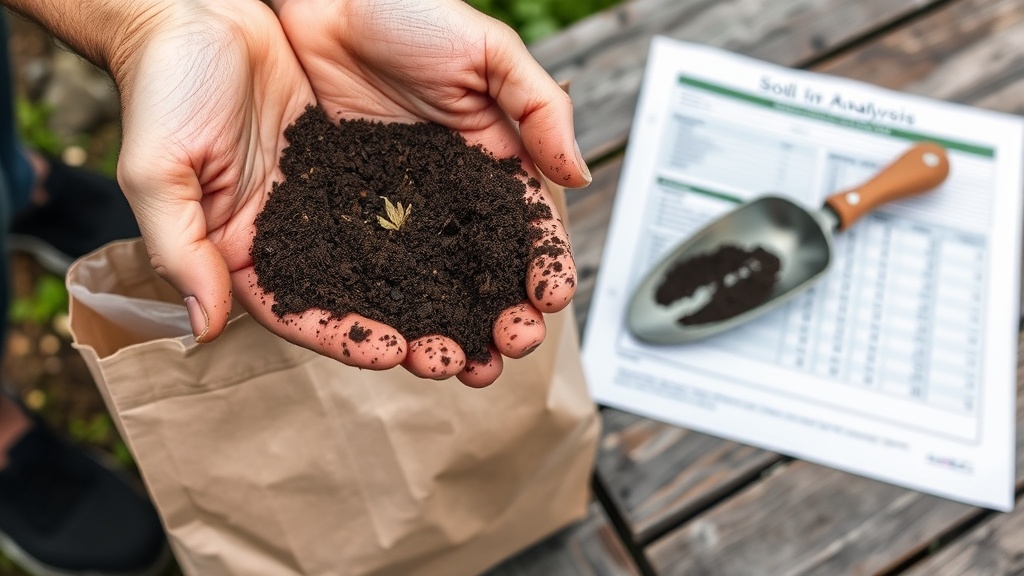
Soil Testing: The Spring Task Everyone Skips (And Why Your Garden Fails for It)

I wasted three years on this. Three years of blaming the weather, blaming the seeds, blaming the deer—when the real problem was sitting two inches under my feet.
I didn't test my soil.
Not once. I'd look at a bed, see that beautiful dark color, think yep, that's good dirt, and shove plants in. I was buying amendments based on vibes. I was lime-ing beds that didn't need it because my neighbor did and her tomatoes looked better than mine. I was throwing money at a problem I hadn't bothered to diagnose.
The year I finally mailed a sample to NC State Extension was the year everything changed. I got back a two-page report with actual numbers—pH, nitrogen, phosphorus, potassium, organic matter percentage, cation exchange capacity—and I sat at my kitchen table for twenty minutes just staring at it. One of my raised beds had a pH of 7.4. I had been trying to grow blueberries there for two years. Blueberries want pH 4.5 to 5.5. Those plants were never going to thrive. Not because of anything I did wrong with watering or pruning—because the chemistry was off, and I had no idea.
Here's the thing I want you to internalize before you spend a single dollar on spring amendments: your soil has a story, and that story is written in data. You can guess at it, or you can read it.
Why We All Skip It (And Why That's Dumb, Including When I Did It)
Most gardeners don't test because it feels like extra homework before the fun part starts. Seeds are exciting. Transplants are exciting. Mailing a bag of dirt to a lab and waiting two weeks for a PDF is decidedly not exciting.
Also, we've been trained to trust our eyes. Dark soil means good soil, right?
Wrong. That's the myth that cost me three growing seasons.
Dark color tells you almost nothing about chemistry. Dark loam can be pH 8.0—hostile to most vegetables. Beautiful crumbly tilth can have phosphorus so locked up by high pH that your plants can't access it no matter how much you fertilize. And pale, sandy-looking soil can test at a perfect 6.5 with 5% organic matter and outperform anything that looks "rich."
The only way to know what you're working with is to test it.
DIY Kit vs. Lab Test: When to Use Each
I'm not going to be precious about this. Both have a place.
Home test kits ($10–20, found at any garden center or on Amazon):
- Test pH and basic N-P-K levels
- Results in about 15 minutes
- Good enough to catch major red-flag issues (extreme pH, obvious deficiencies)
- Miss micronutrient detail, organic matter %, and soil biology
- Good choice if you're on a tight budget and testing annually to catch drift
State extension lab tests (through the NC Department of Agriculture & Consumer Services Agronomic Division):
- Full N-P-K (available, not just total), pH, organic matter %, lime index, and recommendations specific to what you're growing
- Results typically take 1–2 weeks; expect longer during the spring rush when the lab is slammed
- Professionally interpreted—the report tells you exactly what to add and how much
- One of the most affordable state soil testing programs in the Southeast—check current pricing at ncagr.gov (look for the Agronomic Division)
- Worth doing at minimum once every 3 years even if you're doing DIY tests in between
My rule: If you've never tested your soil, start with the lab test. Once you know your baseline chemistry and you're doing annual maintenance, a home kit for quick pH checks is fine between lab tests. But that first test? Do it right.
To order, search "NC Agronomic Division soil testing" or go to ncagr.gov and look for the Agronomic Division. They walk you through the submission process, provide the sample containers and instructions—follow their packaging guidelines exactly, because the lab is particular about how samples arrive. It's unglamorous. It works.
The Numbers on My Report (Real Data, Spring 2024)
Here's what I got back for my main vegetable beds last spring, so you have a reference point:
- pH: 6.3 — Right in the sweet spot for most vegetables (6.0–6.8 is ideal)
- Phosphorus: 140 lbs/acre available — Adequate; no additions needed
- Potassium: 190 lbs/acre available — Good; save your potassium amendments
- Calcium: 1,780 lbs/acre — Adequate
- Magnesium: 210 lbs/acre — Adequate
- Organic matter: 4.8% — Solid, approaching my target of 5%+
- CEC (cation exchange capacity): 12.4 meq/100g — Good for Asheville's clay-loam soils
Compare that to my ornamental front bed, which I tested the same year:
- pH: 7.1 — Too alkaline for most shrubs; I'd been adding wood ash without thinking
- Phosphorus: 310 lbs/acre — Way too high; I'd been over-fertilizing for years
- Organic matter: 2.9% — Below threshold; water retention and microbial life were suffering
Same garden. Completely different soil chemistry. Same gardener, totally different management approach needed.
The One Number That Changes Everything
If your lab test comes back and you don't know where to start, look at organic matter percentage first.
Everything else—pH drift, nutrient availability, water retention, microbial life—is downstream of organic matter. Low OM means:
- pH fluctuates more because there's less buffering capacity
- Nutrients you add wash out or lock up faster
- Clay soils compact more aggressively
- Sandy soils drain too fast to support roots
- Microbial populations tank, which means slower nutrient cycling
The Rodale guidelines put minimum viable OM at 3% for productive vegetable beds. Under 3%, you're working against chemistry every single season. Target for Asheville's clay-heavy soils should be 5%+ for good water retention through our summer dry spells.
The catch: you can't fix organic matter fast. It takes 3 to 5 years of consistent input to meaningfully raise OM percentage. But the strategy is simple, and it doesn't require expensive products.
My protocol:
- 1–2 inches of finished compost worked into the top 4–6 inches of soil each spring
- Mulch beds in summer and fall with wood chips or shredded leaves (feeds soil biology as it breaks down)
- Cover crops in off-season beds (crimson clover or winter rye)—till in or cut down before spring planting
That's it. No $60 bottles of microbial inoculant. No fancy soil activators. Just organic matter, consistently added, year after year. The results in my soil journal from 2022 to 2026 are clear: OM in my main beds went from 3.2% to 4.8%. Yields in those beds went up roughly 30% over the same period.
Reading Your Soil Report Without Getting Lost
When the report comes back, here's how to parse it without a chemistry degree:
pH: The scale runs 1–14, with 7 as neutral. Most vegetables want 6.0–6.8. If you're below 6.0, add agricultural lime (dolomitic lime is standard in NC). If you're above 7.0, add elemental sulfur. The report will tell you exactly how much per 1,000 sq ft. Follow the recommendation.
NPK (Nitrogen-Phosphorus-Potassium): The report gives you "available" levels—what matters, not total amounts locked in unavailable forms. High phosphorus (above 200 lbs/acre available) means stop adding phosphorus. It doesn't become harmful to plants at those levels, but you're wasting money. Low potassium means add greensand or wood ash.
Lime Index: NC State includes this number—it tells you how much buffering capacity your soil has. Low lime index means pH is harder to adjust and you may need more lime than you'd expect.
The Recommendations Box: This is the best part. For each crop type you listed on the submission form, they give specific amendment rates. Read this before you buy anything.
WARNING: Never buy amendments without a test result. If you're at the garden center in March holding a bag of sulfur or a bag of lime, put it down and go home. Get the test first. Wrong amendments at wrong rates can wreck your soil chemistry worse than doing nothing.
pH Targets for the Plants in Your Yard
Quick reference for Asheville-area gardens:
| Plant Type | Target pH Range |
|---|---|
| Most vegetables (tomatoes, peppers, squash, beans) | 6.0 – 6.8 |
| Brassicas (kale, broccoli, cabbage) | 6.0 – 7.0 |
| Blueberries | 4.5 – 5.5 |
| Rhododendrons and azaleas | 4.5 – 5.5 |
| Strawberries | 5.5 – 6.5 |
| Corn | 6.0 – 6.8 |
| Potatoes | 5.0 – 6.0 (slightly acid reduces scab) |
| Herbs (basil, parsley, oregano) | 6.0 – 7.0 |
If you're growing blueberries in Asheville, get a separate test for that bed. Our regional soils often run 6.0–6.5 naturally—perfect for vegetables, fatal for blueberries. To acidify, you need elemental sulfur applied months in advance. Not a quick fix.
When and How to Sample
Timing matters more than most people realize.
Ideal windows:
- Late fall, after harvest but before hard freeze (soil chemistry stabilizes with low recent fertilizer input)
- Early spring, before any spring amendments—exactly now, early March, is perfect for Asheville
How I collect my samples:
- Use a clean trowel or soil probe—no metal that's been sitting in fertilizer
- Pull samples from 8–10 spots across the bed, at 6-inch depth
- Mix all the pulls in a clean bucket
- Fill the submission bag from the mixed sample (about 1 cup is all they need)
- Label clearly: what I'm growing in that bed, whether I added anything recently
One sample per distinct bed. Don't mix your vegetable beds with your flower beds or your side yard—those are different growing environments with different histories.
Timeline: Mail in early March, factor in 2–4 weeks for results depending on lab volume, and you're looking at mid-to-late March with results in hand. That's ideal timing to apply amendments before a late April/early May planting. Asheville's average last frost is around mid-April; you want amendments worked in at least 3 weeks before transplants go in.
ACTION: Get your soil tested this week. Search "NC Agronomic Division soil testing" to get started. The program is state-subsidized and costs a fraction of what you'll spend on amendments you might not need.
My March Workflow
Here's exactly what I do every spring, in order:
- First week of March: Pull soil samples from all active growing beds. Mail to the NC Agronomic Division.
- Third week of March: Results back. Read recommendations, note what's needed and what's not.
- Late March: Apply only what the results indicate. Work in compost (2 inches). Apply lime or sulfur if pH is off.
- April 1–15: Allow amendments to integrate. Plant cool-season crops (brassicas, lettuces, spinach) in beds ready to go.
- May onward: Warm-season transplants go in. Soil has been acting for 4–6 weeks.
This is not a complicated system. The part that took me years to do was step one.
The Short Version
Don't spend $200 on plants and amendments for soil you haven't diagnosed.
A few dollars and two to four weeks of patience will tell you more about why your garden succeeds or fails than any seed catalog, any YouTube tutorial, any book on companion planting. Get the test. Read the report. Then—and only then—go shopping.
If you're reading this in early March, you're in the window. Get samples in the mail this week, and you'll have results back with time to amend before your first transplants go in. The NC Agronomic Division lab is your friend. It's one of the least-used resources available to Asheville gardeners and one of the most valuable.
Go get your hands dirty in a useful way this week. Collect the sample. Mail the bag. Wait for the report.
Everything else follows from knowing what you're actually working with.
Callie Rivers gardens on a 1/4 acre in Asheville, NC. Her soil journal runs from 2022 to present—four years of test results, amendment records, and harvest notes from a suburban lot she refuses to treat like a lawn.