Rewilding Isn't Messy—It's Liberation: How to Transform Your Yard into a Pollinator Paradise (Without the HOA Wars)
Hey friends, okay—let's look at something that's got the whole gardening world buzzing right now (pun very much intended).
I'm standing in my yard here in Asheville at 8 AM on a February morning, coffee in hand, watching a male mason bee inspect the hollow reed I hung up last fall. The air smells like damp earth and possibility. And here's what I'm seeing everywhere—everywhere—in 2026: Rewilding.
Not the "let it all go to seed and call it nature" kind. The intentional, beautiful, designed kind. The kind where your yard becomes a humming, buzzing, fluttering ecosystem that also happens to look like something out of a vintage botanical illustration.
Let me tell you why this trend has me doing a little happy dance, and how you can jump on board without your neighbors leaving passive-aggressive notes in your mailbox.
🌿 The Numbers Don't Lie (And They're Actually Encouraging)
So here's what's wild: 12% of American adults—about 32 million people—are actively converting parts of their lawn to natural or wildflower landscapes. That's not a fringe movement, friends. That's a full-blown shift in how we think about the ground beneath our feet.
And get this—research from the National Wildlife Federation shows that gardens with native plants support four times more wildlife than traditional lawns. Four times! I'm talking butterflies, native bees (my beloved mason bees), songbirds, even the beneficial wasps that keep your tomato hornworms in check.
*(Full disclosure: I used to think "beneficial wasp" was an oxymoron. I was wrong. They're tiny, stingless parasitic wasps and they are fierce.)*
🦋 Why "Rewilding" Is the Wrong Word (And Why I Use It Anyway)
Here's my gripe with the term "rewilding"—it implies you're just... letting go. Walking away. And that scares people. It makes them picture knee-high weeds and angry HOA letters.
But the rewilding I'm seeing in 2026? It's intentional ecology. It's choosing to replace that thirsty, chemically-dependent grass carpet with plants that belong here. Plants that evolved alongside our native pollinators. Plants that don't need you to baby them because they already know what to do.
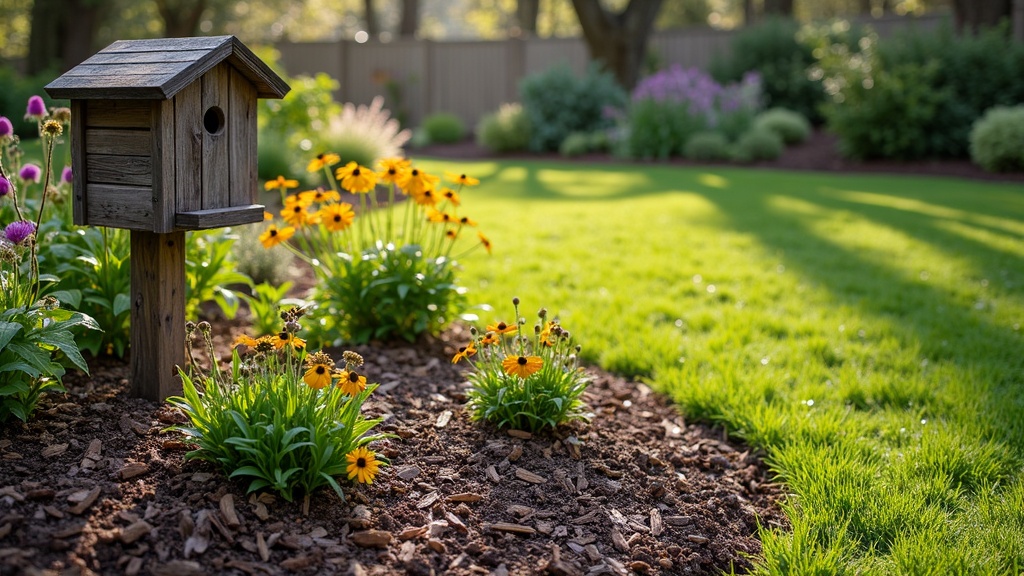
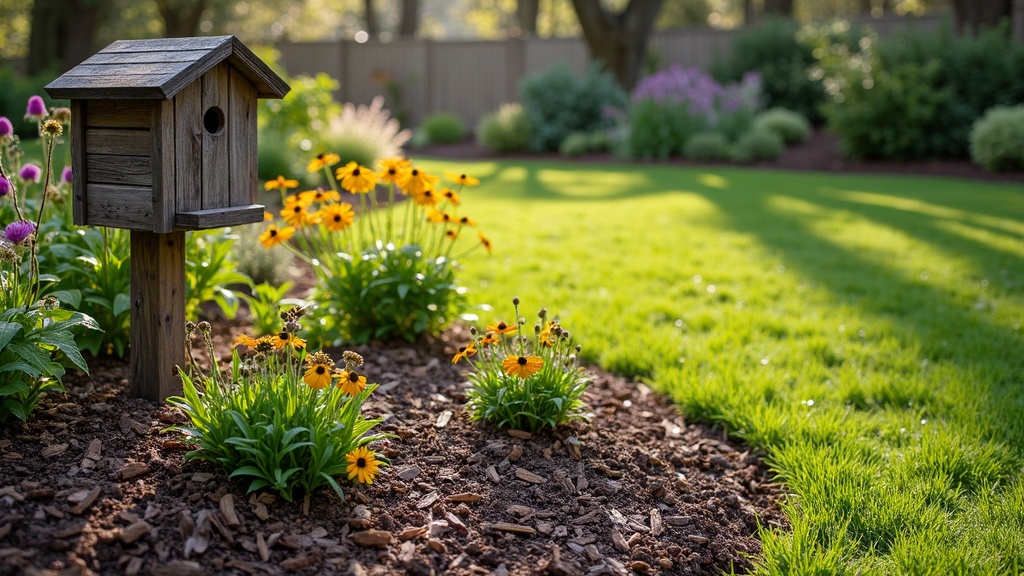
In my own yard, I've replaced about 60% of what was once lawn with:
- Eastern Purple Coneflower (Echinacea purpurea) – the pollinators lose their minds for this stuff
- Wild Bergamot (Monarda fistulosa) – smells like Earl Grey tea, feeds everybody
- Swamp Milkweed (Asclepias incarnata) – monarchs, obviously, but also a dozen other pollinators
- Prairie Blazing Star (Liatris pycnostachya) – those purple spikes in late summer? Chef's kiss.
And you know what? It looks designed. Because it is. This isn't chaos—it's choreography.
🏡 The HOA Question (Let's Address the Elephant in the Room)
"But Callie," I hear you saying, "my HOA will fine me into oblivion if I stop mowing."
Fair. But here's the thing—rewilding doesn't mean no maintenance. It means different maintenance. And I've got three strategies that have worked for me and dozens of "Joyful Stewards" in my community:
1. The "Cultivated Wild" Edge
Keep a mowed strip—maybe 3-4 feet—along sidewalks and property lines. Frame your wild plantings with clean edges. It signals intentionality. This is gardening, not neglect.
2. Signage Is Your Friend
I have a small, weathered wooden sign near my front walkway that says "Pollinator Habitat—Certified Wildlife Garden." Cost me $12 at a craft fair. It transforms the narrative from "weeds" to "conservation." Your neighbors see purpose, not problems.
3. Start Small and Strategic
You don't have to rip out your entire lawn in one weekend. (Honestly, please don't—your soil will revolt.) Start with a corner. A strip along the fence. A "pocket meadow" where nothing else grows well anyway.
My first rewilding project was a 10x10 foot corner that got terrible sun and worse drainage. Nothing grew there except moss and my disappointment. Now it's a voluptuous patch of swamp milkweed and Joe Pye weed that butterflies fight over in August.
🌱 Right Now in Zone 7: What I'm Actually Doing
Since I know some of you are itching to get started—here's what's happening in my Asheville yard this very week:
Direct Seeding: I'm scattering seeds of larkspur, bachelor buttons, and poppy directly into the garden beds. These hardy annuals need that cold stratification—the freeze-thaw cycles of late winter actually wake them up. It's called vernalization, and it's nature's alarm clock.
Soil Prep (The No-Dig Way): I'm adding a fresh layer of arborist wood chips to the paths between my raised beds. Not tilling—never tilling. Just feeding the soil from the top down and letting the mycorrhizal fungi do their invisible, magical work.
Wildflower Planning: I'm sketching out where to add more natives this spring. The seed catalogs are out. I'm eyeing some blanket flower (Gaillardia pulchella) for that hot, dry spot by the driveway where grass has always struggled.
*(Yes, I sketch my garden plans. Yes, I use colored pencils. No, I am not embarrassed about this.)*
🐝 The Unexpected Joy
Here's what nobody tells you about rewilding: it's not just about the pollinators. It's about you.
When you stop fighting your yard—when you stop pouring chemicals and water and frustration into keeping grass alive that wants to die—you get something back. Time. Money. Sanity.
I used to spend three hours every weekend mowing, edging, spraying, fertilizing. Now? I spend that same time watching ruby-throated hummingbirds duel over bee balm. I drink my coffee while mason bees (I name them all Eleanor) move into the reed houses I hung in March.
My water bill dropped 40% last summer. My "lawn care" expenses basically vanished. And my yard? It's the talk of the neighborhood—in the good way. I have neighbors stopping by to ask what that "gorgeous purple flower" is. (It's Liatris. You're welcome, Sharon.)
✨ The Big Win: Your First Step
Okay, I promised you one actionable takeaway, and here it is:
This week, identify one 100-square-foot patch of lawn that you never use. Maybe it's that weird corner by the air conditioning unit. Maybe it's the strip between your driveway and the neighbor's fence. Maybe it's the spot where the dog has already killed the grass anyway.
Take a photo of it. Measure it. Then do a quick search for "native plants + [your state] + pollinators." Your state extension office probably has a list. Your local native plant society definitely does.
Pick three plants. Just three. Order the seeds or find a native plant nursery near you.
And then—this is the hard part—stop mowing that patch. Lay down cardboard to smother the grass. Pile on 4 inches of mulch. Wait.
By August, you'll have something alive and humming where there was once just... green carpet.
That's not messy, friends. That's liberation.
What's your rewilding story? Have you started converting lawn to habitat? Drop a comment below—I want to hear about your wins, your failures, and your favorite native plants. And if you're in the Asheville area, I'm organizing a native plant swap in March. Stay tuned to the Sunday Soil newsletter for details.
Now get outside and feel some soil. No gloves allowed.
— Callie