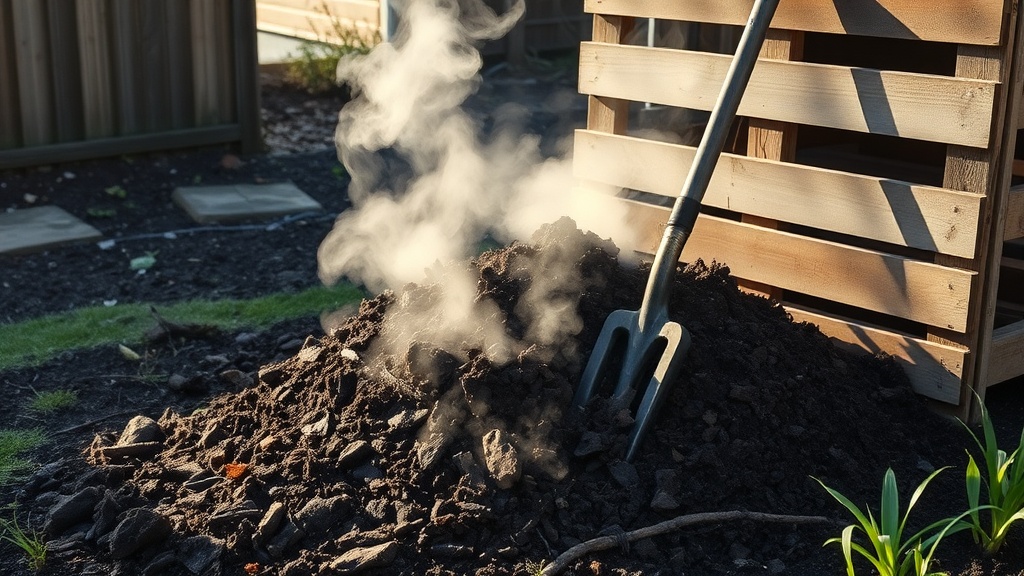
Hot Composting in March: Build a Pile That Cooks in 6 Weeks

I killed my first compost pile. Just straight murdered it with good intentions and too many grass clippings.
This was back in my landscape design days, before I understood that composting isn't throwing organic matter in a heap and waiting for nature to do something. I'd built this gorgeous three-bin system out of reclaimed pallets—looked fantastic in the client's yard—and then filled it with a solid eighteen inches of fresh grass clippings topped with some leaves I found in a bag by the curb. Two weeks later, the whole thing smelled like a swamp. Anaerobic. Slimy. The kind of smell that makes your neighbor stop being friendly.
I've been hot composting on my quarter-acre in Asheville for six years now, and March is when I get serious about it. Here's why spring is your best shot at building a pile that actually cooks—and how to do it without the swamp phase.
Why March Changes Everything for Composting
Hot composting needs thermophilic bacteria, and those bacteria need ambient temperatures above 50°F to really get moving. In Asheville's zone 7b, we're hitting consistent daytime highs in the mid-50s to low 60s by mid-March. Night temps still dip, but the thermal mass of a properly built pile holds its own heat. By April, you've got enough ambient warmth that the pile practically runs itself.
The other reason March works: you've got materials. Winter cleanup gives you brown, carbon-rich stuff—dead leaves, dried perennial stalks, cardboard from all those seed orders. And the first spring growth gives you nitrogen—early weeds (before they seed), kitchen scraps from all that winter cooking, coffee grounds. You've got both halves of the equation sitting in your yard right now.
The Ratio That Actually Matters
Everyone talks about the 30:1 carbon-to-nitrogen ratio by weight, and everyone's eyes glaze over because nobody is weighing their compost ingredients. Here's how I actually think about it:
Two parts brown, one part green, by volume. That's it. Two buckets of dead leaves for every bucket of kitchen scraps. Two wheelbarrows of straw for every wheelbarrow of fresh grass clippings. You don't need a scale. You need a rough visual estimate and the willingness to adjust.
If the pile smells bad—too much nitrogen. Add browns. If the pile sits there doing nothing for two weeks—not enough nitrogen. Add greens. Your nose and a compost thermometer are better diagnostic tools than any formula.
How I Build a Hot Pile in One Afternoon
I do this all at once. That's the key difference between hot and cold composting—you're not adding to it over time. You're building the whole thing in one session so the microbial community can establish itself uniformly.
Step 1: Gather everything first. I need roughly a 3×3×3 foot pile minimum. That's about 27 cubic feet of material. Sounds like a lot, but it compresses fast. I collect:
- Dried leaves (I keep bags of them from fall—if you didn't save any, ask a neighbor, they'll be thrilled)
- Cardboard torn into hand-sized pieces, tape removed
- Kitchen scraps saved over a week or two
- Any green weeds I've pulled during early cleanup
- Coffee grounds from my kitchen and sometimes from the café down the road
- A few shovels of finished compost or garden soil for microbial inoculation
Step 2: Layer like you're making lasagna. Four inches of browns. Two inches of greens. Sprinkle of soil. Repeat. Water each layer until it feels like a wrung-out sponge—damp but not dripping. This is the part people skip, and then they wonder why nothing happens. Moisture matters as much as the ratio.
Step 3: Walk away for three days. Then stick a compost thermometer in the center. If you're between 130°F and 160°F, you're cooking. If you're below 120°F, the pile needs more nitrogen or more moisture. If you're somehow above 170°F (it happens with too many grass clippings), spread the pile out for a few hours and rebuild it.
Step 4: Turn it. I turn my pile every 4-5 days for the first three weeks. Outside material goes to the center, center material goes to the outside. This is the workout part. I won't pretend it's effortless—my bypass pruners stay in my pocket and I grab a pitchfork instead. Each turn restarts the heating cycle.
The Finished Product Timeline
A well-managed hot pile started in mid-March gives me finished compost by late April or early May. That's 6-8 weeks. Cold composting the same materials would take 6-12 months. The math sells itself.
You'll know it's done when it smells like a forest floor after rain—that rich, dark, earthy smell that has nothing in common with the original ingredients. The temperature stops rising after turning. The volume has shrunk by about two-thirds. It looks like dark chocolate cake crumbles. If I can still identify a banana peel or a recognizable leaf, it's not done.
What I Don't Put in the Hot Pile
I'm more relaxed about this than most composting guides, because a true hot pile kills weed seeds and pathogens at sustained temperatures above 140°F. But I still skip:
- Meat and dairy. Not because the pile can't handle them—it can—but because raccoons will disassemble my bin at 2 AM to find them.
- Diseased plant material. Black spot on roses, late blight on tomatoes—these go in the municipal green waste, not my pile. I don't want to gamble.
- Glossy paper and anything with synthetic coating. Cardboard is fine. The shiny flyer from the pizza place is not.
- Pet waste. Different pathogens, different conversation, different composting system entirely.
My Favorite Asheville Cheat Code
The coffee shops on Haywood Road will give you bags of spent grounds if you ask nicely and bring your own bucket. Coffee grounds are almost perfectly balanced at around 20:1 C:N, and they're one of the best compost accelerators I've found. I pick up a five-gallon bucket once a week during pile season. Free nitrogen, diverted from the landfill, and you get to feel smug about it. Everybody wins.
If you're in the Asheville area, the city's compost facility on Meadow Road also sells finished compost by the truckload if you need inoculant for your pile or just want to see what the end product should look and smell like. It's worth the trip even if you don't buy anything—seeing a commercial-scale operation puts your backyard pile in perspective.
Start Ugly. Adjust Later.
The best compost pile I ever built was also the ugliest. It was a mix of half-rotted leaves, pulled chickweed, cardboard boxes I'd been meaning to recycle for three months, and an embarrassing amount of banana peels. It hit 155°F in four days and gave me the darkest, richest compost I've ever produced.
Perfection is not the goal. Participation is. Build the pile this weekend. Get your hands in it. If it smells wrong, fix it. If it doesn't heat up, add more greens and water. The microbes will figure it out—they've been doing this for a few billion years longer than any of us.
Your soil is waiting. And honestly, so is that pile of leaves you keep meaning to deal with.